 Grasp Execution Without a Planner
Configuration-Space Grasp Distance Fields with Certified Safety & Guaranteed Quality
Institute for Systems Research, University of Maryland, College Park, MD, U.S.A.
Grasp quality preservation via a wrench-quality CBF limits degradation of the realized force-closure margin after hold onset.
Individual Trials (6)
reach-grasp-lift sequence
quality margin retained by realized grasps
per 20 ms control step
with no planned or stored trajectory
Abstract
Mainstream plan-then-track approaches to multifingered grasp execution entail selecting a grasp, planning a collision-free trajectory, and tracking the resulting trajectory via a feedback controller. Pose-estimation error during execution or scene motion can invalidate this open-loop commitment and trigger replanning. We thus present Grasp Distance Fields (GDFs), smooth softmin distances to finite sets of arm-hand grasp configurations. Using their negative gradients as feedback, we jointly select and execute grasps without planning a trajectory. A CBF-CLF quadratic program (QP) enforces self-collision, workspace, object, and obstacle-clearance constraints, while its CLF slack quantifies obstruction of task progress. We bound the softmin approximation error by $\log N/\rho$ and prove forward invariance of the filtered safe set. To handle changes in contact topology, we combine a hysteretic contact-mode transition with a wrench-quality CBF that limits degradation of the realized force-closure margin relative to hold onset. Using our method, a fixed-base manipulator and a Unitree G1 equipped with the same underactuated hand grasp and lift 46 of 50 test objects amid clutter and moving obstacles. The realized grasps also retain a median 94% of their synthesized quality margin, and each QP solve requires 0.09 ms within a 20 ms control interval.
Grasp Distance Fields in Configuration Space
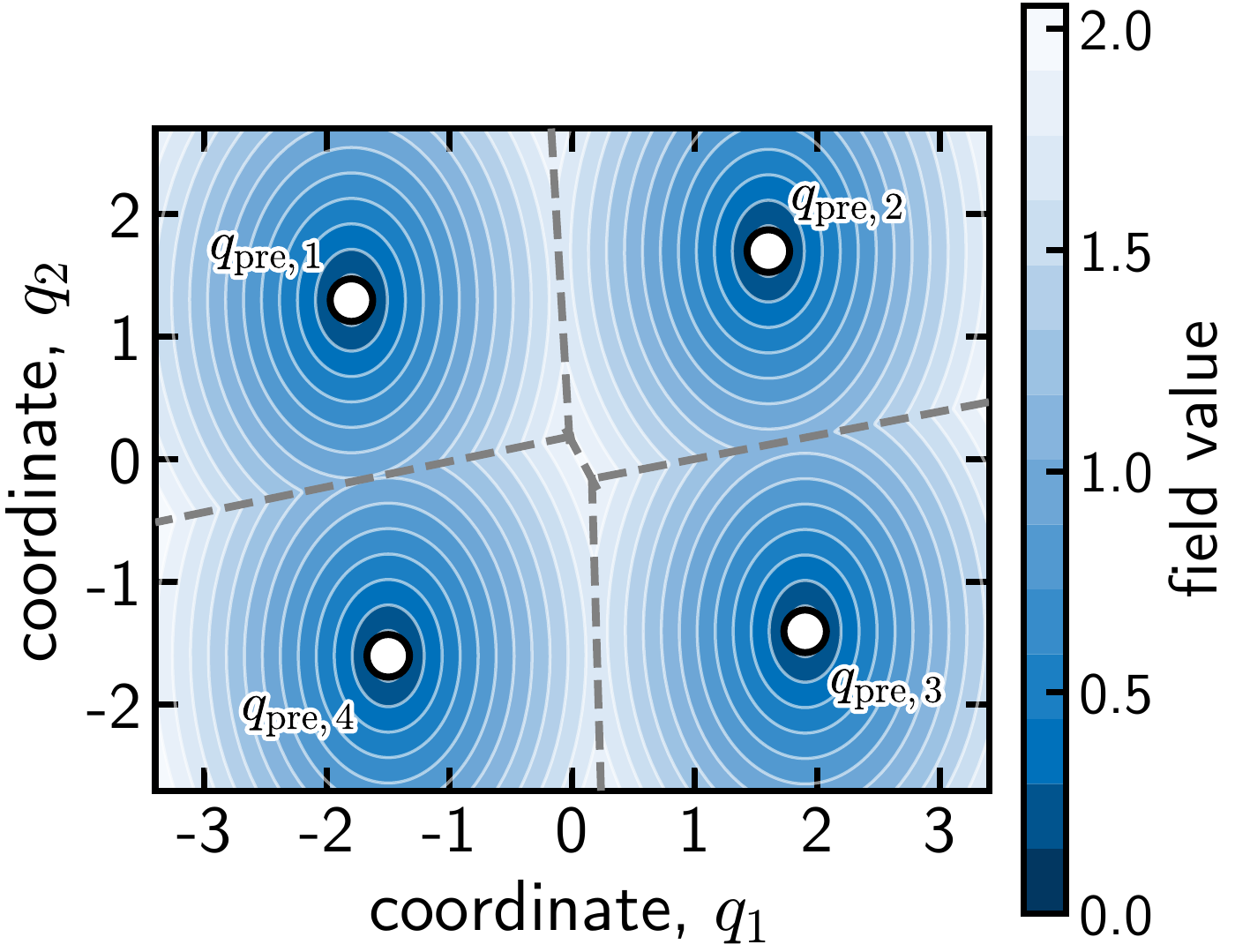
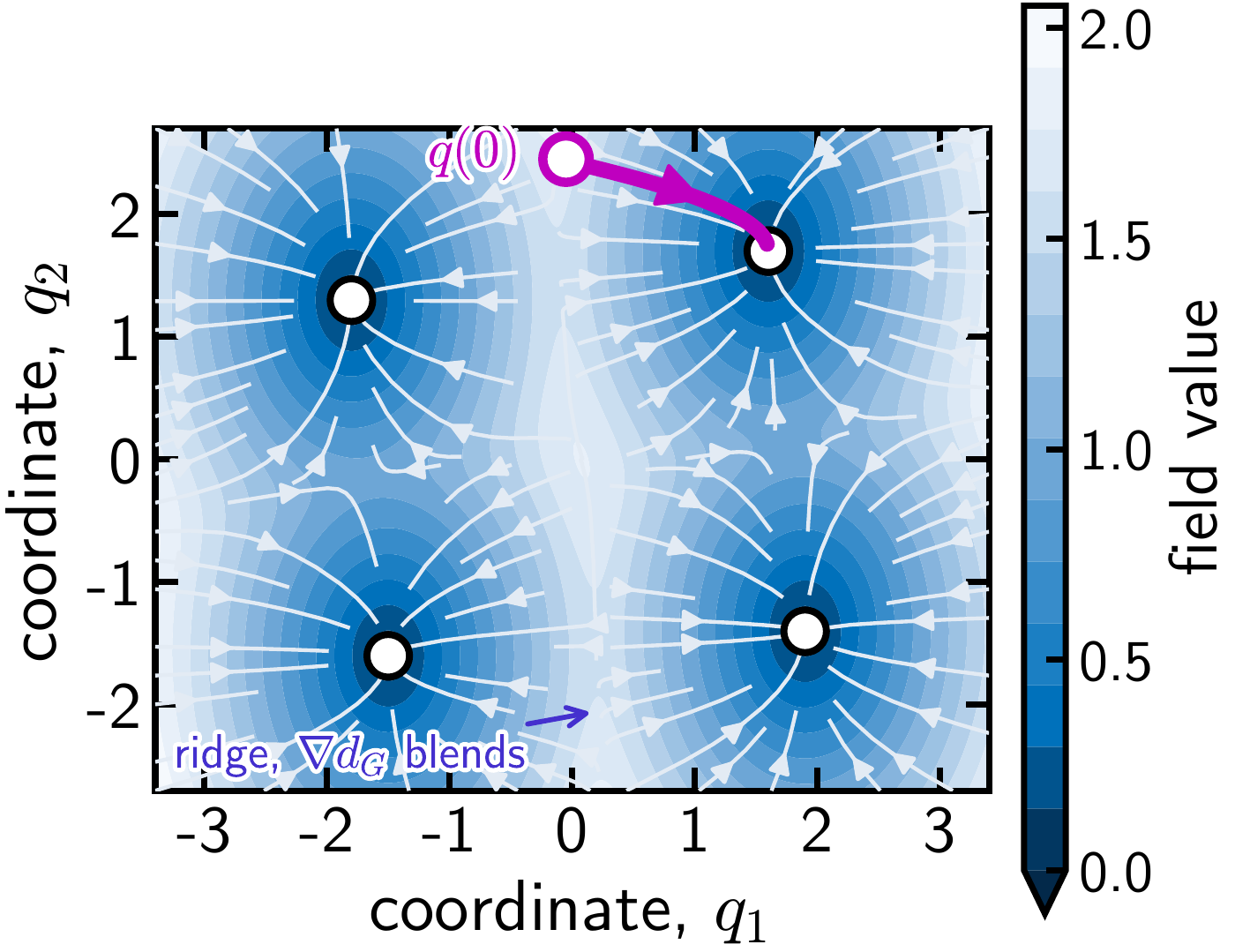
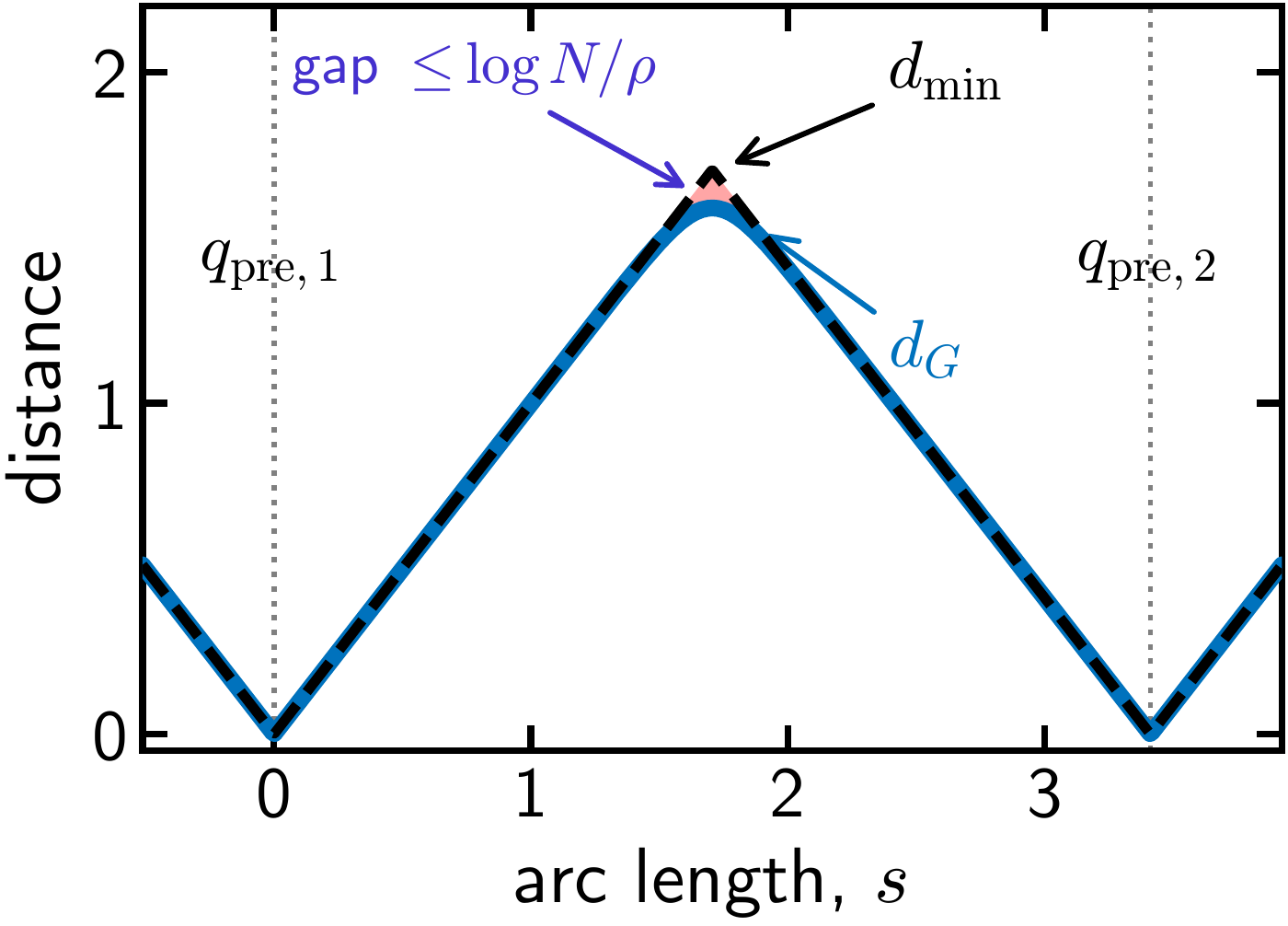
We represent the grasp target by a finite set $\mathcal{G} = \{q_i^{\text{pre}}\}_{i=1}^{N}$ of arm-hand pregrasp configurations. The hard set distance $d_{\min}(q)=\min_i \lVert q_i^{\text{pre}}-q\rVert_{\Lambda}$ is nonsmooth on candidate Voronoi boundaries, so the controller uses the smooth softmin $d_G(q)=-\tfrac{1}{\rho}\log\sum_i\exp(-\rho\,\lVert q_i^{\text{pre}}-q\rVert_{\Lambda})$. It satisfies $d_{\min}(q)-\log N/\rho \le d_G(q) \le d_{\min}(q)$, and its gradient is a softmax-weighted convex combination of the candidate-distance gradients. The nominal command $v_{\mathrm{nom}}=-k\nabla d_G$ therefore requires no discrete grasp-selection step; the softmax weights interpolate candidate selection at every evaluation. At each control step, a CLF-CBF quadratic program filters this nominal velocity through the active safety constraints, while an admission test rejects candidates whose pregrasp or closure violates a barrier constraint.
Grasp Distance Field
The GDF is a smooth softmin distance to a finite pregrasp set, with approximation error bounded by $\log N/\rho$ and a bounded gradient.
Safe Execution Law
A CLF-CBF QP enforces self-collision, workspace, object, and obstacle-clearance constraints as hard constraints, relaxes convergence through nonnegative slack, and encodes the underactuated hand through dependent-joint equalities.
Contact-Mode Switch
A hybrid mode structure over REACH, CLOSE, HOLD, and LIFT changes the active constraint set so fingertip contact can be admitted without sacrificing the safety constraints that remain active.
Wrench-Quality CBF
At hold onset, a wrench-quality CBF limits degradation of the realized risk-adjusted force-closure margin relative to its hold-onset value.
Humanoid Instantiation
The same controller runs on a Unitree G1 model with the same underactuated hand; platform-specific structure comes from the rigid-body model and a grasp record synthesized for that embodiment.
Quality-Constrained Evaluation
Our wrench-quality constraint prevents the controller from lifting after the realized closure certificate degrades beyond its hold-relative bound. We repeat the descriptor-set evaluation with this constraint active and every other parameter fixed. Because the constraint activates only at entry into HOLD and the controller is deterministic, the quality-neutral and quality-constrained configurations reach HOLD identically on every record. The quality-constrained controller completes 45 lifts, one fewer than the quality-neutral configuration. In the single changed box trial, the hand forms a three-finger contact set whose realized margin falls from $1.51\times10^{-3}$ at hold onset to $-0.32$, against a descriptor certified at $1.83\times10^{-3}$. The quality-neutral controller proceeds through the certificate loss and lifts the grasp, whereas the wrench-quality constraint makes the program infeasible 25 control steps after hold onset and the trial stops in HOLD.
Physics simulation separates the two outcomes. We transfer each held configuration at entry into LIFT to a Drake simulation with a fixed wrist and implicit proportional-derivative finger actuation, then increase an upward force on the object to $1.5\,mg$ over one second. The certified grasp holds through the full force increase with at most $1.5~\mathrm{mm}$ of lateral drift, while the uncertified three-finger configuration drops the object under gravity alone. All 45 completed quality-constrained lifts end within $k_{\mathrm{wq}}=0.02$ of their hold-onset margins, and 44 satisfy the bound at every evaluated control step. One contact-set change violates the bound transiently and recovers to a $0.006$ deficit by the end of the lift. Median end-of-lift quality ratios are $0.932$ with the constraint and $0.936$ without it, so the constraint leaves the median essentially unchanged while acting on the large-degradation case.
Interactive Playback
The controls below play recorded execution data from three representative reach-avoid-stay trials: the fixed-base arm-hand system with static obstacles, the same system with a moving obstacle, and the Unitree G1 instantiation with static obstacles. Use the tabs to switch trials and the playback controls to inspect the timeline. The readouts report time, active mode, Grasp Distance Field value $d_G$, minimum barrier value, and contact count through REACH, CLOSE, HOLD, and LIFT.
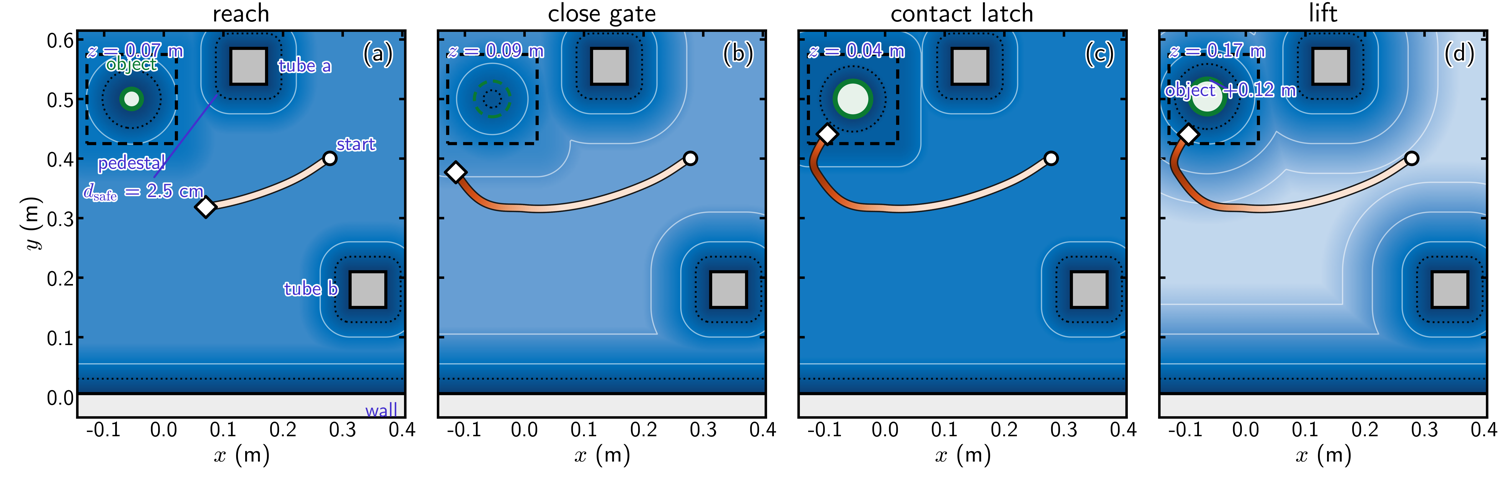
Top-down workspace view of the recorded execution. The palm trace is shown relative to the target and obstacles, and the bar at the right edge reports lift height.
Certified Grasp Descriptor Evaluation
Our controller completes the full reach-grasp-lift sequence on 46 of the 50 objects${}^{\dagger}$, each behind a rectangular obstacle placed next to its approach path. The test set contains four geometric primitives, 17 YCB household objects, and 29 adversarial EGAD meshes. Because the hand still forms a contact set in the two HOLD failures, we evaluate 48 realized grasps in all. Of these, 37 satisfy $\varepsilon_{\mathrm{exec}}^{(\beta)} \ge 0$ at $\beta = 0.9$, while the min-weight baseline classifies 39 as force closed and places 30 above $\bar{\ell}^{*} \ge 0.3$. This descriptor-set evaluation runs without the wrench-quality constraint, so the $\varepsilon_{\mathrm{exec}}^{(\beta)}$ values score the realized grasps post hoc.
| Object class | Objects | Lift | $\varepsilon^{(\beta)} \ge 0$ | Force closed | $\bar{\ell}^{*} \ge 0.3$ |
|---|---|---|---|---|---|
| Primitives | 4 | 4 | 3 | 3 | 2 |
| YCB household | 17 | 14 | 12 | 12 | 10 |
| EGAD adversarial | 29 | 28 | 22 | 24 | 18 |
| All | 50 | 46 | 37 | 39 | 30 |
${}^{\dagger}$The four incomplete trials terminate at unsatisfied mode guards rather than safety violations. Two remain in CLOSE after the hand fails to attain the three contacts required by the CLOSE-HOLD guard within the 700-step horizon. The other two reach HOLD but do not satisfy the LIFT guard. The QP remains feasible throughout these four trials.
Results
In a reference trial, we place a sphere from the descriptor set behind a pair of $6 \times 6 \times 50$ cm rectangular obstacles. No unobstructed approach to the object exists. The filtered closed loop avoids the obstacles, with the palm deviating by up to 20.5 cm from the nominal path, and completes the 12 cm rise. Both obstacle constraints remain positive at every control step, with a minimum of 6.7 mm. The realized grasp retains $r=0.912$ of the descriptor's certified risk-adjusted margin, $3.05\times10^{-3}$ versus $3.35\times10^{-3}$, while the corresponding min-weight margins are 0.446 and 0.468.
Our controller updates obstacle poses at every control step and handles a moving obstacle without changing the feedback law. We translate a $5 \times 5 \times 45$ cm obstacle at 0.05 m/s across the arm's approach path. The filtered closed loop steers around the obstacle and continues the approach, with the palm path deviating by up to 19.1 cm from the nominal path and true surface clearance remaining positive at a minimum of +8.4 mm. Because the implemented constraint omits the $\partial h/\partial t$ term, the obstacle CBF can fall below zero by at most $v/\alpha_0=10$ mm in this trial; the measured minimum is $-6.6$ mm, within the 1.5 cm obstacle margin.
We instantiate the controller on a humanoid to test whether the platform-specific structure comes from the rigid-body model alone. We combine the 29-degree-of-freedom Unitree G1 body with the same 11-joint hand at the right wrist and fix the legs and left arm, leaving a 21-dimensional fixed-pelvis chain. With a $4 \times 4 \times 36$ cm obstacle on the palm-to-object line, the closed loop completes the 12 cm rise in 434 steps with no infeasible step. The minimum obstacle-constraint value is 3.8 mm, true surface clearance is 3.4 cm, the filtered palm path deviates by up to 9.7 cm from the nominal path, and torso rotation remains below 18 degrees through the lift.
Research in Progress
Manipulation in Human-Shared Workspaces
In a separate study, we investigate bimanual assembly in a workspace shared with a moving person. The A7-L6 bimanual robot manipulator transports, aligns, and inserts the part while maintaining housing support.
BibTeX
@online{enweremGraspDistanceFields2026,
  title     = {Grasp Execution Without a Planner: Configuration-Space Grasp Distance Fields with Certified Safety \& Guaranteed Quality},
  author    = {Enwerem, Clinton and Baras, John S. and Belta, Calin},
  year      = {2026},
  eprint    = {2608.00600},
  eprinttype= {arxiv},
  eprintclass = {cs.RO},
  doi       = {10.48550/arXiv.2608.00600},
  url       = {https://arxiv.org/abs/2608.00600},
  pubstate  = {prepublished},
  keywords  = {Computer Science - Robotics, Electrical Engineering and Systems Science - Systems and Control, Mathematics - Optimization and Control},
}