Matching expert task success at one operating condition does not establish robustness preservation as task conditions vary. ParcelStow evaluates the expert–learner performance difference across a controlled variation in execution timing. The difference can widen, narrow, or reverse sign.
A scalar speedup factor r divides selected phase durations: at r = 2, those phases take half as long. Acquisition and settling durations are fixed. We evaluate expert and learner policies across the same speedup factors on three simulated manipulation tasks.
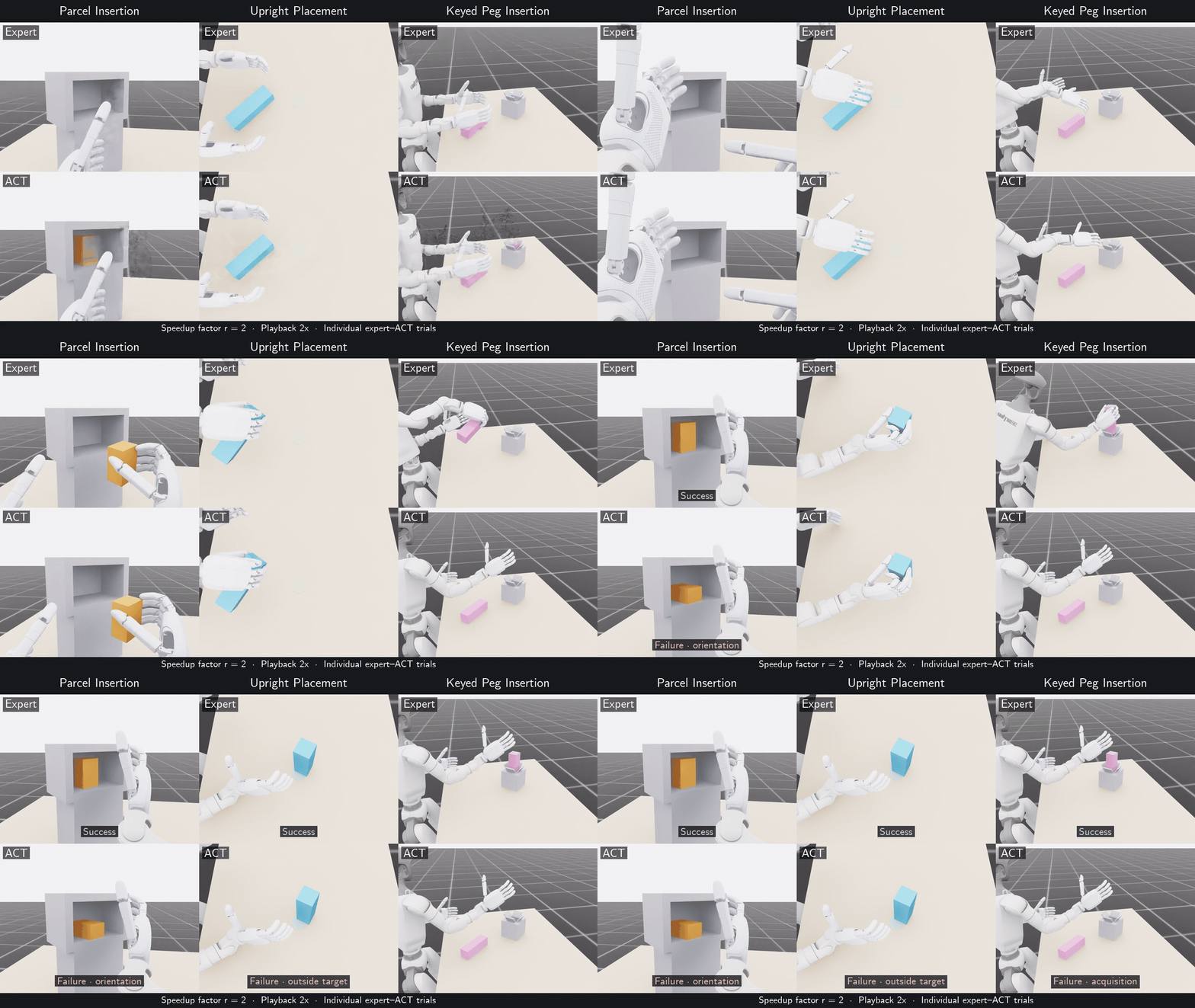
Expert–ACT Comparisons
In the recorded evaluations, ACT matches or exceeds expert nominal task success on all three tasks. At the higher speedup factors shown below, the expert succeeds more often. For parcel insertion, this difference appears within the demonstrated speed range; for upright placement and keyed peg insertion, it appears beyond that range.
| Task | Nominal r = 1 | Higher r | Success at Higher r | ||
|---|---|---|---|---|---|
| Expert | ACT | Expert | ACT | ||
| Parcel Insertion | 100/100 | 100/100 | 2 | 84/100 | 53/100 |
| Upright Placement | 185/200 | 194/200 | 2 | 105/200 | 24/200 |
| Keyed Peg Insertion | 182/200 | 191/200 | 1.5 | 150/200 | 3/200 |
Expert-minus-ACT differences at the highlighted factors are 31, 40.5, and 73.5 percentage points, with pointwise 95% paired bootstrap intervals [18, 44], [32, 49], and [67.5, 79.5]. Each task reports one trained ACT policy; training replications are reported individually in the records.
These evaluations use fixed state-based policies in Isaac Lab simulation. The release also contains Diffusion Policy and DAgger results, together with their pairing status and comparison limits. Explore the evaluation records.
Use the Benchmark
The benchmark includes 937 successful expert demonstrations and 970,565 control steps across the three tasks. Learned policies use 147-dimensional state observations and share a 16-dimensional joint-position action interface with the scripted experts at 50 Hz.
The frozen evaluation bundle contains 136 conditions from 20 source series and 23,200 episodes. Reproduce success counts and paired intervals on a CPU without running the simulator:
git clone https://github.com/coenwerem/parcelstow.git
cd parcelstow
python3 -m pip install numpy
python3 scripts/reproduce_manuscript.py --bootstrap \
--output-dir outputs/reproduce/canonicalUsing ParcelStow?
Citation
@misc{enwerem2026parcelstow,
  title = {Does Imitation Learning Preserve Temporal Robustness in
           Dexterous Manipulation? An Expert-Learner Comparison
           Across Task Execution Speeds},
  author = {Enwerem, Clinton and Baras, John S. and Belta, Calin},
  year = {2026},
  eprint = {2609.01453},
  archivePrefix = {arXiv},
  primaryClass = {cs.RO},
  url = {https://arxiv.org/abs/2609.01453}
}