MuJoCo Model Export#
The exporter converts the hand and object geometry in a compiled MuJoCo model to GraspIt! XML and OFF meshes. It records an affine map from independent coordinates to source hinges and a correspondence between exported links and source bodies. These records support planning in GraspIt! and reconstruction in the source scene. The kinematics guide derives the reference-angle conversion. See Todorov, Erez, and Tassa for MuJoCo.
We compared corresponding source and exported link vertices at matching
joint coordinates. For the evaluated right RealHand L6 scene, the maximum
symmetric Hausdorff vertex distance across 49 configurations and 12 links
was below 0.01 µm in each mesh mode. Across all five exported
hands and 75 configurations per mode, the largest recorded distance was
approximately 1.3 µm, for Inspire in convex_hull mode. These measurements
refer to the evaluated source scenes and sampled configurations.
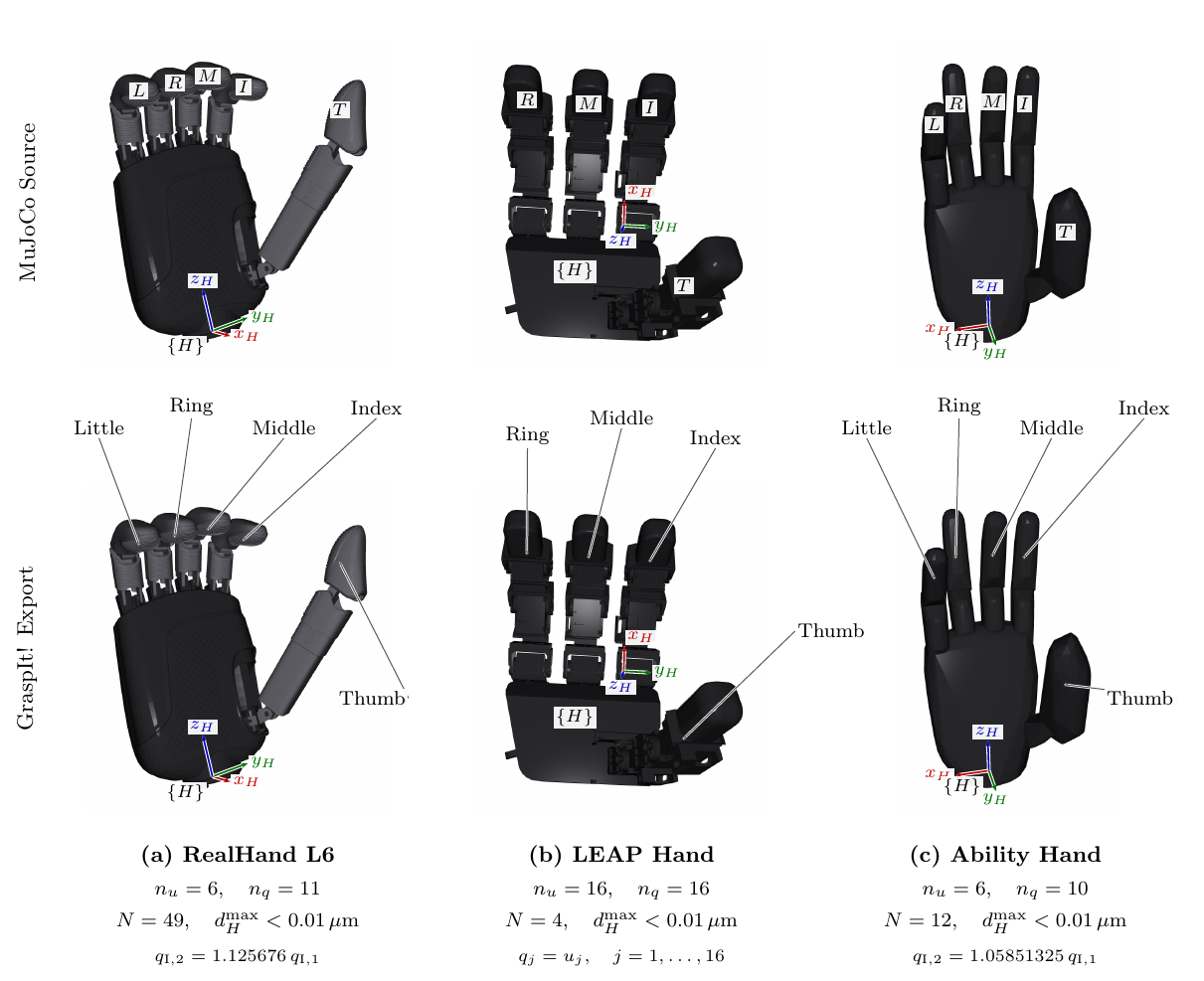
Source and exported hand geometry at corresponding configurations. Palm frames and finger labels identify the correspondence used in the link-vertex comparisons.#
Export a Hand and Object#
Install the mjcf extra from Installation. Exporting
geometry requires MuJoCo; loading the export in GraspIt! requires the
native installation. Load an MJCF or URDF scene and select the palm as
the hand root and the rigid object’s body as the object root. The hand
export covers the palm and finger subtree. The arm and scene geometry remain
in the source scene.
This example assumes input/scene.xml contains bodies named palm and
object. Replace those names with the names in your model.
import mujoco

from graspit_py.convert.mjcf_hand import export_body, export_hand

model = mujoco.MjModel.from_xml_path("input/scene.xml")
hand = export_hand(model, "palm", "output/hand", name="my_hand")
object_xml = export_body(model, "object", "output/object")
The output has the following structure; <body> is a source moving-body
name, with a wrapper and mesh for each exported link.
output/
├── hand/
│   ├── my_hand.xml
│   ├── my_hand.json
│   └── iv/
│       ├── palm.xml
│       ├── palm.off
│       ├── <body>.xml
│       └── <body>.off
└── object/
    ├── object.xml
    └── object.off
Pass hand.robot_xml and object_xml to the
contact planner. Keep the hand XML beside its iv/
directory and the object XML beside its OFF mesh. Exported mesh vertices
use millimeters; the object XML records mass in grams. export_body
uses the body name for its filenames unless name is supplied, so a
body named cube produces cube.xml and cube.off by default.
Read the Hand Manifest#
ExportedHand provides robot_xml, dof_joints, chains, and links.
The adjacent JSON file serializes these same fields. dof_joints lists
independent coordinates in exported order. Each item in a chain records
the source joint name, driving DOF index, affine multiplier and offset,
and source joint range in radians. links maps comma-separated chain
and link indices to source body names; it has no palm entry.
The following schema example represents a synthetic serial finger with one independent coordinate and two hinges. The identity coupling and ranges illustrate the fields; they are not parameters of an evaluated hand.
{
  "robot_xml": "output/hand/my_hand.xml",
  "dof_joints": ["finger_base"],
  "chains": [[
    {
      "mujoco_joint": "finger_base",
      "dof": 0,
      "ratio": 1.0,
      "offset_rad": 0.0,
      "range_rad": [0.0, 1.0]
    },
    {
      "mujoco_joint": "finger_tip",
      "dof": 0,
      "ratio": 1.0,
      "offset_rad": 0.0,
      "range_rad": [0.0, 1.0]
    }
  ]],
  "links": {"0,0": "finger_base_link", "0,1": "finger_tip_link"}
}
For each source hinge, reconstruction applies
\(q_i=\mathrm{ratio}_i u_{\mathrm{dof}_i}+\mathrm{offset\_rad}_i\).
The offset already accounts for source reference angles. Independent
hinges have multiplier one and offset zero. Use attribute access with
an in-memory ExportedHand; use dictionary indexing after loading its
JSON with json.loads.
Choose the Mesh Collision Representation#
The default mesh_collision="source" exports source mesh triangles,
including concavities. To export the collision representation of
standard MuJoCo mesh geoms, select their compiled hulls.
hand = export_hand(model, "palm", "output/hand", name="my_hand",
                   mesh_collision="convex_hull")
object_xml = export_body(model, "object", "output/object",
                         mesh_collision="convex_hull")
For each mesh geom, let \(V_g\) denote its compiled hull vertices and \(T_g\) its rigid transform into the export frame. The exported mesh contains the boundary triangles of \(T_g\,\operatorname{conv}(V_g)\). A link with multiple mesh geoms retains their independently transformed hulls in its OFF file. The exporter preserves the compiler’s triangle connectivity and winding. Both modes use the same primitive tessellation and affine joint map. Hull mode raises an error for SDF or plugin colliders or when a mesh has no compiled hull.
Prepare the Source Model#
Each finger is a serial chain with one hinge on each moving body.
Fixed bodies are assigned to the nearest moving ancestor or the palm.
The exporter transfers collision meshes and tessellates boxes, spheres,
capsules, cylinders, and ellipsoids. A geom participates if it has
nonzero spatial extent and either contype or conaffinity is nonzero.
Supply participating geometry for the palm and every articulated link.
Supported joint equalities express a driven hinge as an affine function
of an independent hinge. For a compiled displacement equality with
coefficient \(c_0\), multiplier \(a\), and reference angles \(q_f^0,q_d^0\),
the absolute reconstruction offset is \(q_f^0+c_0-aq_d^0\). The manifest
stores that offset. preshape_joints assigns zero autograsp velocity to
named independent coordinates, preserving their caller-set values
during closure. It does not choose their preshape values.
For rigid objects, export_body expresses the named body and its
descendants in that body’s frame at the reference configuration.
Pass include_descendants=False to select the named body alone.
Reconstruct a Candidate in MuJoCo#
Use the same source scene and hand manifest that produced the planning
inputs. The standalone example below expects output/candidates.json
from the planning CLI. The scene must contain the palm body palm and
an object body object with a free joint named object_free; replace
all three names together if your scene differs. A fixed object needs
a different placement strategy.
The code restores the closed hinges, keeps the palm at its source
world pose, and places the free object to reproduce the candidate’s
object-relative palm pose. For transforms \(T_{AB}\) mapping coordinates
from frame \(B\) to frame \(A\), this construction is
\(T_{WO}=T_{WH}T_{OH}^{-1}\). The candidate stores \(T_{OH}\) as
T_object_hand_mm; convert its translation to meters for MuJoCo.
import json
from pathlib import Path

import mujoco as mj
import numpy as np

model = mj.MjModel.from_xml_path("input/scene.xml")
data = mj.MjData(model)
manifest = json.loads(Path("output/hand/my_hand.json").read_text())
result = json.loads(Path("output/candidates.json").read_text())
if not result["candidates"]:
    raise RuntimeError(result["rejections"])
candidate = result["candidates"][0]

for chain in manifest["chains"]:
    for joint in chain:
        u = candidate["dofs_rad"][joint["dof"]]
        data.joint(joint["mujoco_joint"]).qpos[0] = (
            joint["ratio"] * u + joint["offset_rad"]
        )
mj.mj_forward(model, data)

palm_name = "palm"
object_name = "object"
object_joint_name = "object_free"
object_joint = model.joint(object_joint_name)
if model.jnt_type[object_joint.id] != mj.mjtJoint.mjJNT_FREE:
    raise ValueError(f"{object_joint_name} must be a free joint")
if model.jnt_bodyid[object_joint.id] != model.body(object_name).id:
    raise ValueError("The free joint must belong to the object body")

palm = data.body(palm_name)
T_OH = np.asarray(candidate["T_object_hand_mm"], dtype=float)
R_WH = palm.xmat.reshape(3, 3)
R_WO = R_WH @ T_OH[:3, :3].T
p_WO = palm.xpos - R_WO @ (T_OH[:3, 3] * 0.001)
q_WO = np.empty(4)
mj.mju_mat2Quat(q_WO, np.ascontiguousarray(R_WO).ravel())
data.joint(object_joint_name).qpos[:] = np.r_[p_WO, q_WO]
mj.mj_forward(model, data)
The hinge assignments leave unrelated joint coordinates at their initialized values. To reconstruct into a recorded source state, restore that state before applying the map. If the object must remain fixed, \(T_{WH}=T_{WO}T_{OH}\) instead defines a palm-pose target for the application’s arm kinematics.
Verify Link Geometry#
examples/check_export_geometry.py compares corresponding source and
exported link vertices in the palm frame. Supply the source scene,
palm name, and a JSON list of joint vectors in exported DOF order,
in radians. This command uses the Docker image from
Installation and a source palm named l6_hand_base_link.
mkdir -p output
docker run --rm --user "$(id -u):$(id -g)" \
  -v "$PWD/input:/input:ro" -v "$PWD/output:/output" graspit-py \
  xvfb-run -a python /src/examples/check_export_geometry.py \
    /input/scene.xml l6_hand_base_link /input/configurations.json /output/parity \
    --mesh-collision convex_hull
Use --mesh-collision source to compare source mesh vertices.
geometry-check.json records the mode, each link’s maximum symmetric
Hausdorff vertex distance in millimeters across the configurations,
the greatest requested-to-applied DOF discrepancy, and the tolerance
result. These are comparisons of the selected geometric representation
at the supplied coordinates.