MuJoCo Model Export
The exporter converts the hand and object geometry in a compiled MuJoCo model to GraspIt! XML and OFF meshes. It records an affine map from GraspIt! coordinates to source hinges and a correspondence between exported links and source bodies. Together these records allow planning in GraspIt! and reconstruction of the resulting configuration in MuJoCo. The kinematics guide derives the reference-angle conversion. See Todorov, Erez, and Tassa for the MuJoCo simulator.
We evaluated each simulator at corresponding joint coordinates to compare the exported and source geometries. Across 49 configurations of the right RealHand L6 and 12 links, the maximum symmetric Hausdorff distance between corresponding link-vertex sets was 7.86 nm.
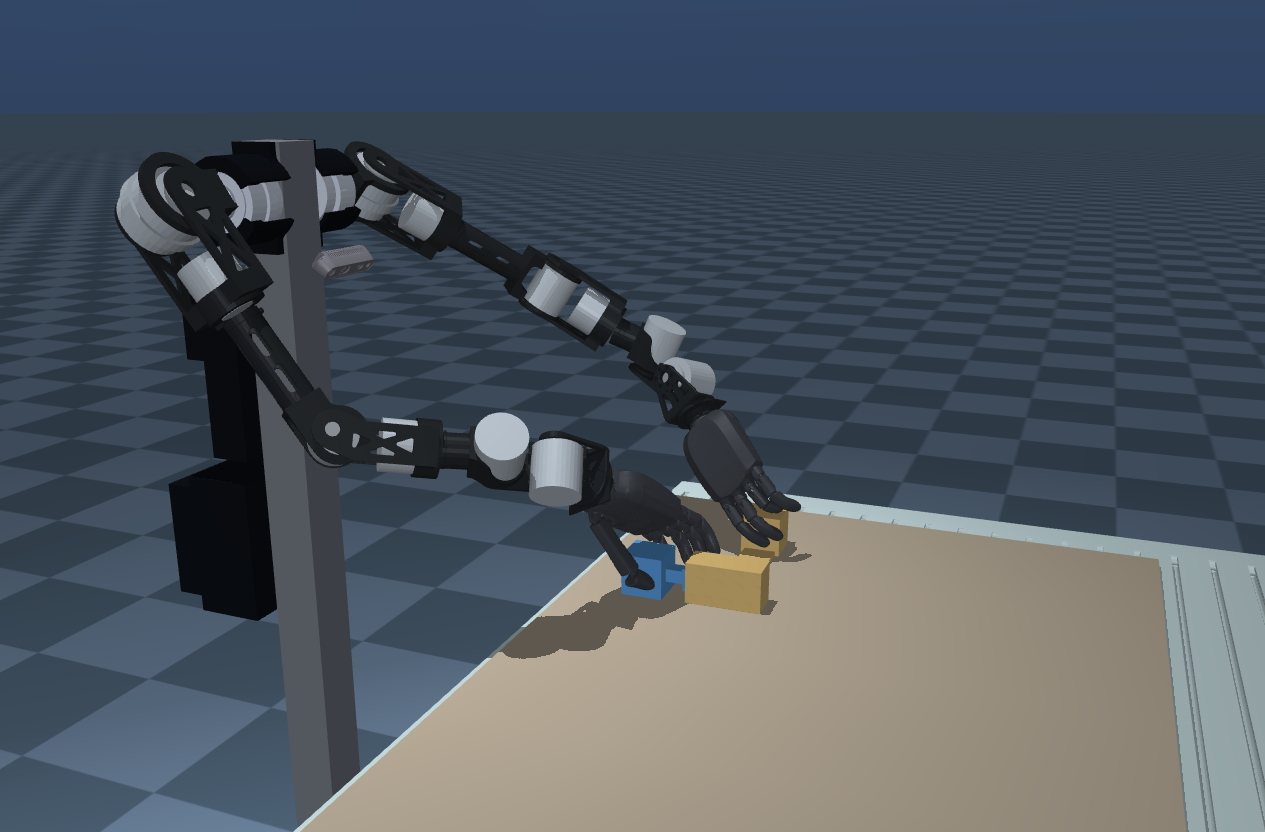
MuJoCo source workcell during a recorded bimanual insertion.
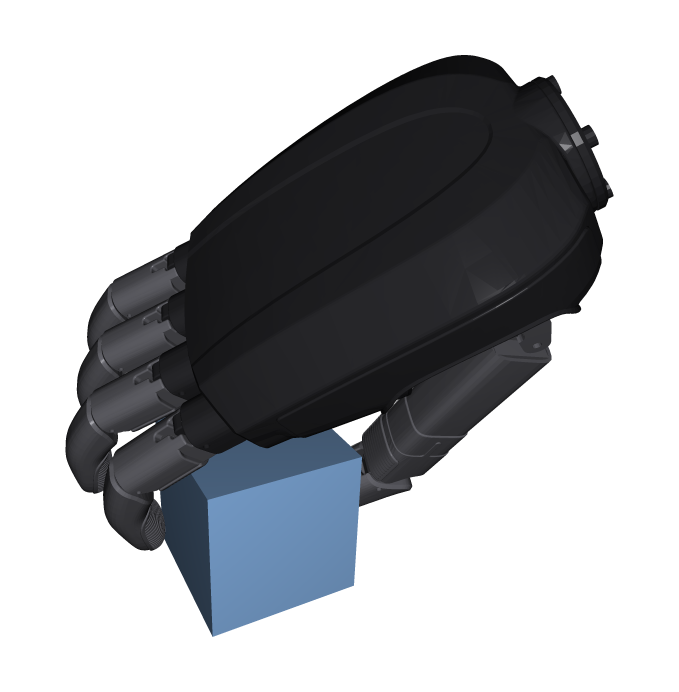
GraspIt! configuration of the exported right L6 at the planned key grasp.
Export a Hand and Object
Load an MJCF or URDF scene in MuJoCo and pass the compiled model to the exporter. Select the palm as the hand root and the rigid object’s body as the object root. The hand export covers the palm and its finger subtree. The robot arm and workcell remain in the source scene.
import mujoco

from graspit_python_wrapper.convert.mjcf_hand import export_body, export_hand

model = mujoco.MjModel.from_xml_path("scene.xml")
hand = export_hand(model, "palm", "output/hand", name="my_hand")
object_xml = export_body(model, "object", "output/object")
Pass hand.robot_xml and object_xml to the
contact planner. Keep the hand XML adjacent to its
iv/ directory and the object XML adjacent to its OFF mesh. Mesh
vertices in both exports use millimeters. The object export records
mass in grams.
Prepare the Source Model
Each finger is a serial chain with one hinge on each moving body.
Fixed bodies are assigned to the nearest moving ancestor or to the
palm. The hand exporter transfers collision meshes and tessellates
boxes, spheres, capsules, cylinders, and ellipsoids. A geometry
participates if it has nonzero spatial extent and either contype
or conaffinity is nonzero. Supply participating geometry for the
palm and each articulated link.
The supported joint equalities express one driven hinge as an affine
function of one independent hinge. Use preshape_joints to assign
zero autograsp velocity to named independent coordinates, such as a
thumb opposition joint held at a prescribed setting.
For rigid objects, export_body expresses the geometry of the named
body and its descendants in the named body’s frame at the reference
configuration. Pass include_descendants=False to select the named
body alone.
Reconstruct the Hand in MuJoCo
The JSON manifest beside the hand XML lists independent coordinates
in dof_joints. Each record in chains identifies the source
hinge, the driving DOF index, the multiplier ratio, and the angular
offset offset_rad. Apply this map to the closed DOF vector of a
GraspCandidate. The operation preserves the other coordinates in
the MuJoCo state.
qpos = data.qpos.copy()
for chain in hand.chains:
    for joint in chain:
        address = model.joint(joint.mujoco_joint).qposadr[0]
        qpos[address] = joint.ratio * candidate.dofs[joint.dof] + joint.offset_rad
candidate.T_object_hand maps palm coordinates into object
coordinates. The serialized key is T_object_hand_mm. Convert the
translation from millimeters to meters, then left-multiply the
transform by the source object’s world pose. The resulting world-frame
palm pose is a target for the calling application’s arm kinematics.
Verify Link Geometry
The repository provides examples/check_export_geometry.py to evaluate
corresponding export and source link vertices in the palm frame. Supply
the source scene, palm body name, and a JSON list of joint vectors in
exported DOF order, in radians. The command below uses the Docker image
from Installation and writes the comparison to output/parity/.
mkdir -p output
docker run --rm --user "$(id -u):$(id -g)" \
  -v "$PWD/input:/input:ro" -v "$PWD/output:/output" graspit-py \
  xvfb-run -a python /src/examples/check_export_geometry.py \
    /input/scene.xml l6_hand_base_link /input/configurations.json /output/parity
geometry-check.json records the symmetric Hausdorff vertex distance
for each link and configuration in millimeters, the greatest
requested-to-applied DOF discrepancy, and the tolerance result.