Robot Learning · Control · Simulation
Reinforcement Learning for Robotics
Risk-Sensitive Learning · Demonstration-Guided Policies · Physics-Based Simulation
I develop risk-sensitive reinforcement learning algorithms and build simulation pipelines for training, integrating, and evaluating robotic policies. My work includes published distributional RL, a reproduced demonstration-guided dexterous learning baseline, and residual RL integrated with bimanual assembly control.
Learning Baseline Reproduction · MuJoCo / Adroit
From Demonstrations to Learned Dexterous Relocation
I ported the authors’ Demonstration-Augmented Policy Gradient (DAPG) [1] implementation to a maintained Adroit simulation environment, trained a relocation policy from 25 demonstrations, and evaluated the initial and trained policies on held-out reset seeds. Behavior cloning initialized the policy; subsequent DAPG training produced successful object relocation.
Training Configuration
| Demonstrations | 25 author-provided demonstrations; 9,942 samples |
|---|---|
| Training | 5 BC epochs, then 100 DAPG iterations; 4 million control steps |
| Algorithm | Authors’ BC/DAPG implementation and example configuration |
| Runtime | Gymnasium Robotics 1.2.0; MuJoCo 2.3.7 |
| Final Evaluation | Reset seeds 40000–40099; 200 steps per episode; sustained successful-step criterion |
Prior-Data RL Adaptation · Drake Simulation
Integrating Residual RL with Bimanual Assembly Control
I adapted Reinforcement Learning with Prior Data (RLPD) [2] to an A7 bimanual arm–hand system, combining recorded native-controller transitions with online residual-policy interaction. A bounded joint-reference residual acts through the existing feedback controller while the robot stabilizes a housing, acquires and transfers a part, inserts it, and withdraws its hands.
The residual policy adjusts seven arm joint references and learns from prior demonstrations and online interaction. Training used 6,300 prior transitions and 6,300 online decisions, with 100 actor updates and 2,000 critic updates.
Assembly Results by Friction
| Friction | Native | Zero Residual | Initial Policy | Updated Policy |
|---|---|---|---|---|
| 0.70 | 1/1 | 1/1 | 4/4 | 4/4 |
| 0.65 | 1/1 | 1/1 | 4/4 | 4/4 |
| 0.60 | 1/1 | 1/1 | 4/4 | 4/4 |
Published Research · IEEE CDC 2025
Risk-Sensitive Distributional Reinforcement Learning
For reach–avoid navigation, I developed quantile-based action-value iteration with a Conditional Value-at-Risk (CVaR) penalty estimated from the distribution of constraint-violation costs [3]. I integrated the risk-sensitive loss with quantile value estimation and evaluated the learned navigation policies in MuJoCo / Safety-Gymnasium. The paper includes a contraction proof for the action-value update.
Goal Attainment and Violation Costs
100 episodes across five evaluation seeds.
| Algorithm | Goals Reached | Violation Cost (Mean ± SD) |
|---|---|---|
| QR-AVI | 239 | 0.05 ± 0.01 |
| Expected-Value QR-AVI | 329 | 0.06 ± 0.01 |
| CVaR QR-AVI, β = 0.90 | 448 | 0.05 ± 0.01 |
| CVaR QR-AVI, β = 0.95 | 448 | 0.05 ± 0.01 |
Algorithm and Implementation
The learner represents action-value distributions with quantile regression. Kernel density estimation provides a distribution of constraint-violation costs, from which CVaR measures adverse-tail risk. A risk penalty augments the quantile loss before the action-value network update.
Reward Design · Isaac Lab / PhysX
G1 PPO Reward Evaluation
I trained policies in 1,024 parallel Isaac Lab environments to investigate geometric pregrasp rewards.
Pregrasp Reward Comparison
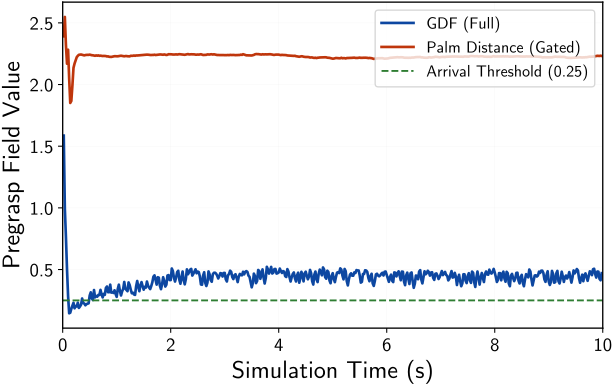
For a fixed-base Unitree G1 equipped with a RealHand L6, the Grasp Distance Field reward measures proximity to candidate arm–hand configurations. PPO training compares this reward with a palm-to-object distance reward.
Evaluation Results
| Reward Configuration | Pregrasp Arrivals | Lifts |
|---|---|---|
| GDF (Full) | 64 / 64 | 0 / 64 |
| Palm Distance (Gated) | 0 / 64 | 0 / 64 |
An arrival occurs when the pregrasp field value falls below 0.25 during an episode. The field measures a smooth minimum of weighted joint-space distances.
References
- Learning Complex Dexterous Manipulation with Deep Reinforcement Learning and Demonstrations.
Aravind Rajeswaran, Vikash Kumar, Abhishek Gupta, Giulia Vezzani, John Schulman, Emanuel Todorov, and Sergey Levine.
Robotics: Science and Systems (RSS), 2018.
arXiv:1709.10087 · Authors’ Implementation - Efficient Online Reinforcement Learning with Offline Data.
Philip J. Ball, Laura Smith, Ilya Kostrikov, and Sergey Levine.
International Conference on Machine Learning (ICML), 2023.
arXiv:2302.02948 · Authors’ Learner - Safety-Aware Reinforcement Learning for Control via Risk-Sensitive Action-Value Iteration and Quantile Regression.
Clinton Enwerem, Aniruddh G. Puranic, John S. Baras, and Calin Belta.
2025 IEEE 64th Conference on Decision and Control, pp. 4890–4895.
DOI: 10.1109/CDC57313.2025.11312575 · arXiv:2506.06954